Sea Limited: How a Gaming Hit Helped Fund a Southeast Asian Shopping Business
Budgeting & Saving [email protected] (Jamie Ward) 326 reads
Sea Limited built a Southeast Asian shopping business on the back of a gaming hit, lost most of its value, then staged a sharp turnaround.
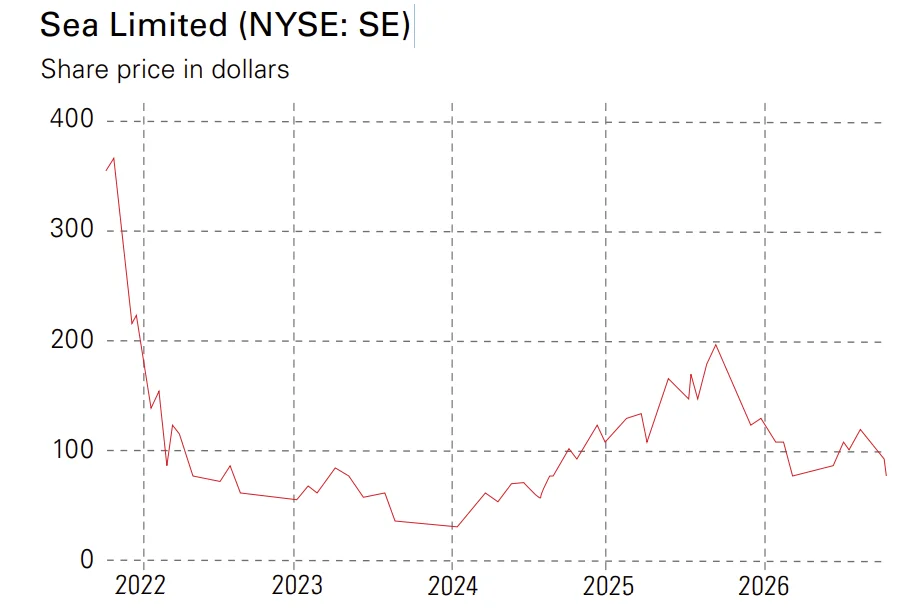
Late 2021 was a high point for Sea Limited. The Singapore-based company, which trades on the New York Stock Exchange as SE, was valued at close to $200 billion. Its shares had climbed above $350 on bets that it could dominate online shopping across southeast Asia and beyond. Within a year, more than 80% of that market value had disappeared. My read is that the swing says less about one bad year and more about how a business built on easy money behaves when the money tap tightens.
The story is also an unusual one. A computer game helped pay for a shopping empire.
Cybercafes and a computer game
Sea started in 2009, when entrepreneur Forrest Li founded Garena to distribute computer games across southeast Asia. Few households had dependable broadband or a personal computer, so Garena worked with cybercafes, installing its software on thousands of machines so customers could play popular online games.
That approach reflected a clear reading of the region. Southeast Asia holds hundreds of millions of consumers, yet its geography, languages and uneven infrastructure make it hard for a business to run smoothly across borders. Garena's edge came from finding workarounds for those obstacles, and that habit of problem-solving would shape everything that followed.
Li soon saw a bigger prize in online shopping. In 2015 he launched Shopee, a website and app where independent sellers offer clothing, cosmetics, household goods and much more. Early on, it focused on small merchants selling inexpensive everyday items. Buyers could chat directly with sellers, and promotions, games and rewards gave them reasons to come back. The model caught on, but winning buyers and building delivery capacity to serve them took enormous amounts of money.
That money arrived from an unexpected place. In 2017 Garena released Free Fire, a game built to run on inexpensive smartphones and patchy internet connections. It grew hugely popular, eventually attracting more than 100 million daily players. The game itself was free, but players could buy virtual items, and those sales brought in substantial profit without the costs of making and shipping physical goods. Free Fire became a valuable source of cash that Sea could direct toward Shopee.
A pandemic boom, then a sharp reversal
Covid lockdowns pushed people to spend more time gaming and shopping online, and both of Sea's businesses benefited enormously. Low interest rates made it easy for investors to fund fast-growing tech companies, even while those companies were losing money.
Sea moved quickly. Shopee subsidised deliveries, offered incentives to merchants and spent heavily on advertising. It expanded into India, Europe and Latin America while building its own delivery network. The company raised billions, including almost $6 billion through a share and bond issue in 2021. With that cash, growth could take priority over profit. By late 2021, investors expected Shopee to become dominant. The plan, though, depended on continued access to funding and on profits from gaming.
The reversal was brutal. Inflation surged in 2022, interest rates climbed, and investors became far less willing to finance businesses that lost money. Gaming slowed as pandemic restrictions lifted. Then India banned Free Fire on security grounds, removing one of the game's largest markets.
Sea faced weaker gaming profits, heavy losses at Shopee and a sharp drop in investor confidence. Spending heavily today in the hope of profits tomorrow was no longer workable. Li moved decisively. Shopee pulled back from much of its international expansion, thousands of jobs were cut, spending was reduced and subsidies were scaled back. The group concentrated on making its remaining operations profitable.
It worked. Sea reported its first quarterly net profit in early 2023. The turnaround looked striking partly because Shopee had relied on large subsidies to attract buyers and merchants, so withdrawing them could have hurt badly. The retreat also exposed pandemic-era mistakes, particularly entering markets where Shopee had little established advantage. Still, Li showed he would abandon weak bets rather than keep pouring money into them.
A different business now
Sea today looks quite different. In 2025 group revenue rose 36% to $22.9 billion, and net profit reached $1.6 billion. Shopee handled $127.4 billion of merchandise, nearly 27% more than the year before.
That scale creates room to grow earnings without repeating the spending spree of the pandemic years. Merchants can pay to advertise their products on the platform, and higher delivery volumes should help spread the cost of the logistics network. Both could let profit grow faster than sales. Online shopping still has room to expand across the region, and Shopee's delivery network may be hard for smaller rivals to match.
Monee is the third piece. It began in 2014 as a payments service that helped gamers without bank accounts buy digital products. It now offers loans and other financial services to consumers and small businesses. Shopee sees how much its merchants sell and how often customers buy, and that data could help Monee assess borrowers that conventional banks often struggle to serve.
The risks that remain
The risks are real. TikTok Shop and Lazada compete fiercely with Shopee. Lending exposes Monee to borrowers who may not repay. Garena still leans heavily on Free Fire, and a game's popularity can't be assumed to last indefinitely.
Li has adapted before and built substantial businesses in markets that still have room to develop. The appeal now is that Sea may be able to earn more from the customers and infrastructure it already has. If that discipline holds, the company's next chapter could look very different from the boom-and-bust cycle of the early 2020s. Whether it plays out that way is still an open question. This is general information about how one company's story unfolded, not a view on whether its shares suit any particular investor.


