Leveraged Diversification: What a Historical Portfolio Study Found
Budgeting & Saving Raph Antoine 453 reads
A reconstructed study suggests global bonds, gold and managed futures may reduce saving needs alongside leverage, but its results weren’t investable returns.

A historical portfolio study raises a useful question for long term savers: could a diversified portfolio with leverage match an all equity strategy while requiring less of a household’s income? Its reported answer is yes, but the result depends heavily on managed futures data reconstructed from history. That makes the finding worth examining, not treating as a ready made savings plan.

What the study compared
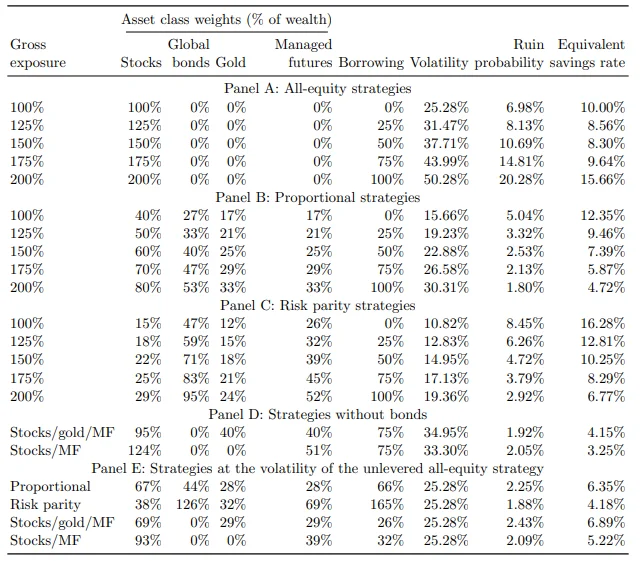
Researcher Guillaume Flament extends an earlier lifecycle study of all equity investing by adding global bonds, gold and managed futures, then examining portfolios that use leverage. The comparison asks how much income a saver would need to put aside under different portfolio approaches to reach outcomes similar to those from an all equity allocation.

The headline result is that a diversified, leveraged portfolio matched the all equity outcome while requiring a saving rate of 6.35% of income, compared with 10% for the all equity case. Those figures describe the study’s modeled results. They are not a promise that an investor using the same broad asset mix could save the difference in real life.

The asset mix matters because the components can behave differently across market conditions. Equities are the growth engine in an all equity portfolio, but they can fall sharply. Bonds, gold and managed futures bring other return patterns into the model. The paper’s argument is that combining these exposures, and using leverage, can produce a more efficient portfolio across the lifecycle it studies.

Why managed futures carry so much weight
The study’s most notable strength and its main limitation sit in the managed futures series. The approach is based on trend following, a strategy that seeks to respond to persistent price movements across markets. The series uses a method associated with AQR, but its historical results are rebuilt using macroeconomic history datasets.

That reconstruction is consequential. A long modeled record can help researchers ask how a strategy might have behaved through a wider range of conditions than a short live track record covers. But a reconstructed record is not a history of returns that investors could actually have earned. The available data, assumptions and implementation choices shape what appears in the backtest.

In this case, the study’s result of matching the all equity outcome while saving less rests mainly on trend following combined with leverage. If that modeled managed futures performance is difficult to reproduce in practice, the headline comparison may not carry over to a household portfolio. Readers should therefore focus on the role this one component plays in the result, rather than interpreting the reported saving rates as a general rule.

Leverage changes the trade-off
Leverage increases exposure beyond the amount of capital invested. That can amplify gains, but it can also amplify losses. It may introduce financing costs and other implementation details that a historical model cannot fully capture. The study’s comparison is therefore not simply a test of adding more asset classes; leverage is part of the mechanism behind the reported outcome.

For a saver, the practical question is not only whether a model delivered a higher return or a lower required contribution. It is whether the portfolio’s losses, financing needs and complexity would be manageable during a difficult period. A portfolio that looks attractive across a long simulation may still be hard to hold through a sharp decline, especially if leverage magnifies losses at the same time that income or access to borrowing is constrained.

There is also a difference between a modeled allocation and a portfolio a person can maintain. Investors need to understand how each exposure is obtained, how often the mix must be adjusted, what borrowing costs apply and how losses could affect the whole account. The study summary does not provide enough detail to quantify those practical costs or identify a suitable allocation for an individual.

How to read the saving rate comparison
The 6.35% and 10% figures are useful as a comparison within the study’s assumptions. They suggest that diversification paired with leverage could reduce the income contribution needed to match the modeled all equity result. They do not show that every saver could safely lower their contributions from 10% to 6.35%, or that either rate is right for a particular retirement goal.
Contribution needs depend on factors beyond an asset allocation, including the time available to save, future spending, income changes and the returns an investor actually receives. The reported percentages should be read as an illustration of how the modeled portfolios compare, not as a household budget recommendation.
The result also doesn’t establish that an all equity portfolio is unsuitable. A simpler portfolio may be easier to understand and maintain, while a more complex leveraged approach may carry risks and operating demands some investors would rather avoid. The right comparison depends on more than the modeled saving rate: it includes how much uncertainty a person can live with and whether the strategy can be implemented as designed.
The practical takeaway
This paper offers a reason to study diversified portfolios across an investor’s lifecycle, especially when bonds, gold and trend following are considered alongside equities. Its most striking finding, however, relies on reconstructed managed futures history and leverage. Those features limit how directly the result can be translated into real world expectations.
For now, the 6.35% versus 10% comparison is best treated as a research question: how much of the apparent advantage survives when strategy data, borrowing costs and practical implementation are accounted for? Until those details are clear, the study can inform a discussion about portfolio design, but it can’t establish a dependable saving target.