CBRE’s real estate services business reaches into data centres and power networks
Debt & Credit Rupert Hargreaves 623 reads
CBRE combines property services with growing data centre and power infrastructure work, while its advisory activity remains exposed to market swings.

CBRE’s business reaches well beyond property sales and office leasing. Its building operations teams manage everyday property needs, while a growing critical infrastructure division works on data centres, power networks and related systems. That mix links a traditional real estate services company to some of the physical assets supporting the digital economy.
Founded in London in 1773 by William Ellis, CBRE has grown into a global real estate adviser with more than 155,000 employees. The source describes it as the world’s largest real estate adviser, with a 25% share of the global market. The company now reports four main segments: advisory, building operations, project management and real estate investments.
Building operations anchor the business
Building operations is CBRE’s largest segment. Analysts projected $12.7 billion in revenue for 2026, about 46% of the company’s forecast $27.2 billion in total revenue. The work is practical and recurring: keeping properties functional, managing facilities and handling the details that owners need to keep buildings operating.
Facilities management is the largest part of the segment, with $8.2 billion in projected revenue. It covers the services needed to run business properties safely, efficiently and sustainably, including day-to-day office operations. Property management, projected at $2.7 billion, deals more directly with the assets: lease reviews, capital spending and rent collection.
Both areas are growing at double-digit rates, according to the figures cited. Their expansion, though, looks modest beside the company’s push into critical infrastructure services. That division serves digital and power infrastructure, including data centres, wireless networks, electric vehicle charging stations and cooling systems.
Two acquisitions are central to that expansion. CBRE bought Pearce Services in November 2025 for $1.2 billion upfront. Pearce provides technical services for digital and power infrastructure. In October, CBRE acquired Onnec Group for £460 million. Onnec specialises in installing and maintaining network, fibre and data centre infrastructure. Together, the acquisitions are expected to add about $1.2 billion in revenue to the critical infrastructure division, compared with the $1 billion it reported in 2025.
Advisory work brings greater exposure to market swings
Advisory is CBRE’s second-largest segment. Its services include leasing, property sales, debt origination, mortgage servicing and valuations for property owners and investors. This work can rise and fall with real estate activity, making advisory the company’s most cyclical major business.
In the third quarter, sales in the segment rose 11%, down from 18% in the previous quarter. Large deals shifting into the third quarter weighed on leasing growth: leasing rose 6% year over year, below analysts’ 16% expectation. US office leasing fell 2%, following 29% growth in the previous quarter. By contrast, valuation and loan servicing income increased, supported by demand for refinancing.
The figures show why CBRE’s different services can move at different speeds. Leasing and property sales depend on transactions and tenant demand. Valuations and loan servicing can benefit when owners refinance existing borrowing. A strong result in one area doesn’t necessarily mean every part of advisory is accelerating.
Development and funds add another source of income
CBRE’s other operations include project management and real estate investments. The latter combines development with asset management, including property investment funds rather than direct ownership of the properties themselves.
Trammell Crow Company is one of CBRE’s main development businesses. It owns entities including UK homebuilder Telford Homes, acquired in 2019, and has an investment portfolio of nearly $30 billion in properties under development or marketed for sale. Development can add to the company’s reach, though it also involves exposure to property projects and the timing of their sale.
Fund management provides a different kind of income. CBRE manages $155 billion in funds for real estate investors and earns management fees as well as performance fees. The source gives a projected 2026 EBITDA margin of 40% for real estate investments, compared with 20.4% for advisory, 10.9% for business services and 16.3% for project management. The projected margin for the group as a whole is 14.2%. Those estimates underline how profitable fund management can be, while also showing that the divisions have quite different economics.
Growth and valuation need to be read together
CBRE’s service focus helps explain why its returns may differ from those of businesses that depend more heavily on property development. Much of its income comes from services, including multi-year contracts linked to inflation. UBS estimates the company’s return on invested capital at 23.7% for 2026, rising to 27.2% in 2027 and 34.8% by 2030. Return on invested capital measures how much profit a business generates relative to the capital it uses.
The company’s two main divisions, advisory and building operations, grew by 25% to 30% over the past two years. Rising demand for office space contributed, particularly for high-end, modern, serviced and well-maintained properties, even as overall office occupancy stagnated. Property valuation, mortgage servicing and mortgage origination services also grew by more than 10% over that period.
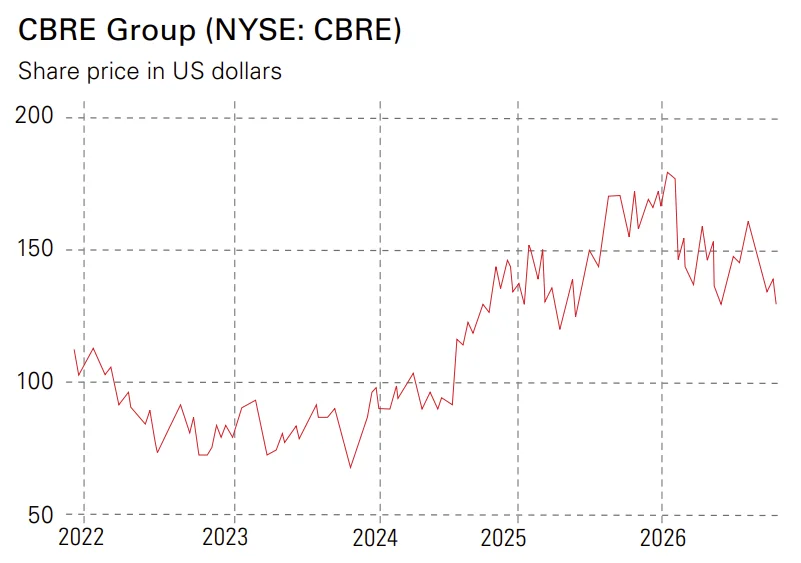
The company’s connection to data centres and other infrastructure hasn’t kept its shares in step with investor interest in AI-related businesses. CBRE still provides services to the buildings and networks that support data centre activity, but its broader real estate profile may lead some investors to overlook that exposure.
UBS puts CBRE’s forward price-to-earnings ratio at 15.7, down from 19.9 in 2023, and projects 13.9 for 2027. The 15.7 figure is nearly one standard deviation below the shares’ 20-year average, according to the source. UBS also forecasts net earnings growth of 20.1% this year, 11.5% in 2027 and close to 10% a year by 2030. These are estimates, not assured outcomes; the advisory business’s sensitivity to property activity remains one factor to weigh alongside the projected growth.
CBRE does not pay a dividend. It is buying back shares, and in 2024 it added $5 billion to an existing $4 billion programme, bringing the total to $9 billion through the end of the decade. For readers assessing the business, the central question is whether recurring property services and infrastructure work can keep expanding while transaction-based advisory income fluctuates. The answer will depend on both the company’s execution and demand across the property market.


