Two Months in Chiang Mai: What One Young Australian Learned About Remote Work and Money
Retirement Planning Dave Gow 418 reads
A young Australian spends two months working remotely from Chiang Mai, tracking every cost and weighing what a cheaper base could mean for his path to financial independence.
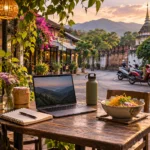
Most conversations about financial independence eventually run into the same wall: the number you need to save is set by what you spend, and what you spend is set by where you live. James, who we first met as a teenager already making serious progress toward financial independence, decided to test that wall directly. He moved his working life to Chiang Mai, Thailand, for two months, tracked every baht, and came back with a clearer read on whether geographic arbitrage is worth a serious look. The food stories are fun. The numbers are the part that matters.

Why a cheaper country made the math hard to ignore
James first came across the idea of living abroad to save faster in Quit Like a Millionaire, a book by Bryce and Kristy that describes how they used geographic arbitrage to reach financial independence. Back then he filed it under interesting but not for him. What changed was steady exposure over several years, mostly through friends who had been working as digital nomads across Southeast Asia, talking about Malaysia, Vietnam and Thailand.
The turning point was a simple calculation. If a move could bring his financial independence date forward by five to seven years, and the lifestyle on the other side was more comfortable, the decision started to look less like a gamble and more like an obvious thing to test. He's clear that cost isn't the only factor. Visas, time zones, health care, social life and career progress all matter. But when a cheaper base shortens the road and improves daily life at the same time, the trade-offs look different.
To make the test possible, James quit his job and found a new employer that allowed fully remote work. That step is easy to skip past, and it's probably the hinge of the whole experiment. Without a role that could follow him across borders, the idea stays a thought experiment.
His longer-term rhythm is a split year: about six months working from Chiang Mai, then six months in Australia living with his parents. Once he reaches his financial independence number, he plans to keep the same split. He's also honest that he'd still prefer to spend at least half the year at home, where his friends and family are, and that the balance could shift later on.
Why Chiang Mai and not Bangkok or Phuket
Several friends had described Chiang Mai as a strong base for remote workers, and James's own research pointed the same way. He liked that it offers a real community of expats and digital nomads, plenty of nature close by, lower costs than Bangkok or Phuket, and a slower pace of life. Those four things together made it feel balanced rather than like a compromise.
There was a personal goal too. James wanted to improve his spoken and written Thai, and a city where daily life happens largely in Thai made that easier than a resort-heavy destination would. He skipped Bangkok, Pattaya and Phuket for a simple reason: they feel more geared toward tourists, and he wanted somewhere quieter.
That choice matters for anyone copying the idea. A city's cost of living, its expat community and its day-to-day feel are separate questions, and the cheapest option on paper isn't always the one you'll enjoy. Chiang Mai scored well on all three for James, but his preferences won't be everyone's.
Two months, one spreadsheet: what it actually cost
James spent from 6 July to 5 September in Chiang Mai, and framed the trip as a low-risk experiment. If he didn't enjoy the city, he could move on to another place in Southeast Asia. In the meantime he was saving money, eating well and seeing a place he otherwise wouldn't have visited. He rates the city 10 out of 10 and says he could see himself settling there long term.

The total came to $3,608 for the two months, or $2,758 without flights. That covered rent, food, entertainment, activities, laundry, a mobile plan and transport. He published both a spreadsheet breaking down the spending and a PDF of every purchase, which is worth a look if you want to see how the categories actually add up rather than relying on a headline figure.
Based on his experience, James estimates that living in Thailand costs about 2.5 to 4 times less than living in Australia, depending on the city. That's a range, not a promise, and it will shift with your rent, your diet, your travel habits and how much you spend on things that have nothing to do with geography.
A workweek built around the time difference
James's working routine stayed close to his Australian one. He works four days a week, Monday to Thursday. Chiang Mai runs one hour behind Australian time, so instead of starting at 7:30am he started at 6:30am and finished around 2:30pm. That left the afternoons open for the gym, errands and the rest of life, which is a useful reminder that a time difference can be an asset when your work is remote and your schedule is flexible.
Weekdays were built around meal planning and home cooking. Weekends were for eating out, and Thai street food in particular. He describes this as a way to keep his diet mostly healthy without cutting out the foods he loves. The balance worked for him, and he kept his weekend eating within roughly maintenance calories so he could still make progress on his health goals.
His everyday routine was simple: work, gym, grocery shopping, cooking and a bit of fun on the weekends. He describes it as a more enjoyable version of his life at home rather than a complete reinvention, which is probably the most realistic way to think about it.
Food, friends and the things that stuck
It's hard to write about James's trip without writing about food. Khao Soi, a Chiang Mai dish of egg noodles in a coconut milk broth, became his favourite Thai dish, and he took a cooking class in August to learn to make it the traditional way. Mango sticky rice, Pad Thai, Pad Ka Prao and spicy sausage salad all made the list. He says he never once ate at a Western restaurant, and meals costing roughly $1.50 to $3 made that easy to stick to.
The cooking class at Ferment Space stood out. He made Khao Soi with his teacher, Aunty Tai, starting from scratch: fresh egg noodles, chili paste ground by hand in a mortar and pestle, and herbs and eggs sourced from the school's farm. They used more egg than a typical restaurant would, which gave the noodles a richer flavour. Afterwards he spent time at the wellness centre, with a nap, the pool, a cold plunge and the sauna. The private class cost 1,200 Baht, or $51.10. The location sits outside the city centre, overlooks a lake surrounded by mountains and is quiet enough that he recommends visiting even without a class.
The elephant sanctuary, Chai Lai Orchid, was the other highlight. James describes watching elephants up close as something you'd normally only see in films. The sanctuary, as he describes it, has no chains, no riding and no abuse, and the elephants roam about 3 acres of land. Visitors are split into groups of five, which he says gave everyone plenty of time with the animals. He bathed, fed and interacted with them, and says what stayed with him was how relaxed and well cared for they looked.

Pushing back on the stereotypes
After two months on the ground, James has a few views on what people get wrong about Thailand. The first is safety. He says he never felt unsafe, including at night, and found people generally respectful of one another. He's also surprised by how warm and welcoming Thai people were in daily life. One memory stands out: a Grab driver approached him unexpectedly while he was walking home and offered him a free ride. It sounded suspicious at first, but the driver seemed genuinely kind, and the two had a good conversation on the way. James thinks Chiang Mai's slow pace makes people friendlier, and that a welcoming place shapes how a whole stay feels.
The second is the idea that Thailand is poor and underdeveloped. James hasn't used the country's healthcare system himself, but he says he understands it to be good and affordable. He also found shopping centres in Thailand better than what he's used to in Australia, with faster internet and more everyday conveniences.
The third is the stereotype of Thailand as a place of wild parties. James says that's a small slice of the country, and that Chiang Mai, with its relaxed pace, doesn't feel like that at all. He notes that the party scene is more likely in Phuket and Bangkok, which is one more reason he chose the city he did.
The downsides he did notice
James is careful to say he didn't have many frustrations. He mentions a few minor ones: some walking paths aren't especially reliable, and Chiang Mai is more humid than most of Australia. He says those were small compared with the upsides.
What he did miss was home. He missed friends and family, which he calls natural on any extended trip. Around week eight he was ready to go back to Australia. Now that he's home, he says he wishes he were back in Chiang Mai. That push and pull is worth taking seriously if you're thinking about a split-year arrangement. The part of your life you're leaving behind doesn't disappear just because the bills are lower somewhere else.
What he'd do differently
James came away with two clear lessons, and both are useful for anyone planning a similar move.
The first is that location matters more than he expected. His accommodation was an Airbnb about 15 minutes outside the city centre. That's fine for a holiday, but it made it harder to meet expats and digital nomads. He doesn't regret it, though. Being further out meant more time with Thai locals, which improved his language skills, and it gave him a good sense of what each part of Chiang Mai feels like. Next time, he knows where he'll stay.
The second is that a good workspace and a community count for more than a flashy amenity. He loved the pool at his accommodation, but he now sees that a decent place to work and a group of people to spend time with matter far more, especially when you're travelling alone. Next year he plans to try a co-living space, which combines both. For solo remote workers, that's a practical point: community is a planning priority, not a bonus.
The plan for next year's longer stint
James is planning a longer trip from June to November next year, five months in total. The longer-term plan is still six months in Australia with his parents and six months with Chiang Mai as his base.
Before booking anything, he needs a DTV visa. He describes it as a five-year visa allowing stays in Thailand of up to 180 days at a time. To extend a stay, he says, you leave the country for 24 hours and return, which he notes is the whole point of the visa. He also says the visa requires a savings balance of 500,000 Baht, or roughly $22,000. He moved money into an offset account, which he says he'll keep for about three months before applying, since a Thai visa consultant told him around three months is typical. He stresses this isn't a hard rule.
Once the visa is sorted, he'll book accommodation and flights. He's weighing two routes. One is five months in Chiang Mai alone. The other is a multi-city plan: two months in Chiang Mai, two in Phuket, three weeks in Da Nang and one week in Bangkok. He's leaning toward the multi-city version because he wants to see more places, but he wouldn't mind staying put for the full five months.
If you're thinking about a similar route, treat his plan as one example. Visa rules, savings requirements and processing times can change, and a visa consultant or the relevant official information is the right place to confirm current details before you commit money.
Where the numbers point, and where they don't
James's advice for anyone in a fully remote role is to ask your employer whether you can work from another country. If you're already pursuing financial independence, a cheaper base can reduce living costs, which raises your savings rate and can shorten the time to your goal.
He also suggests a low-stakes approach: test it for around three months, see how it feels, and if a city doesn't suit you, try another one. That turns a big life decision into a series of smaller experiments, which is a sensible way to approach something this personal.
To show the scale of the effect, James runs a simple comparison. Someone living on $60,000 a year in Australia as a single person might need only about $20,000 for a similar lifestyle in Southeast Asia. If you plan to draw 5% a year from your savings, that means you'd need roughly $400,000 rather than $1.2 million. The arithmetic is clear, but it's an illustration, not a forecast. Real results depend on rent, healthcare, tax, currency movements, travel and many other things that don't stay still. A 5% withdrawal rate is also just one assumption among many.
Still, the point stands. If you're partway toward your financial independence goal, a move to a lower-cost country could bring the finish line closer than you'd think. It's worth at least sketching out the option so you know it exists.
This approach won't suit everyone. Families with children face extra complications, and not every job or industry allows remote work from overseas. Remote work arrangements may also change as technology and employer policies shift, so if you have the flexibility now, it could be worth looking at while it lasts.
Here's my read: the most useful thing in James's story isn't Chiang Mai, or even the Khao Soi. It's that he was exposed to an idea, tested it on his own terms, and came home with real data about his own preferences. Whatever you decide, that's a habit worth copying. Keep saving steadily, stay open to paths that don't look like the default, and treat every big money decision as something you can test before you commit.