Prediction Markets: How Crowd Forecasts Work and Who Profits
Retirement Planning Eve Nicholson 452 reads
Prediction markets turn event forecasts into tradable contracts, but strong trading volumes don’t mean most users make money.
Trading volume can hide who is winning
Prediction markets can look like a powerful way to turn scattered opinions into a forecast. Their appeal is easy to see: a contract has a simple price, trades around the clock and can be sold before the outcome is known. But the popularity of these platforms says little about whether an average user is likely to profit. Research cited in the source points to a sharp divide between a small group of winners and a much larger group of people who lose money.
The basic contract is straightforward. Users trade “yes” or “no” positions on whether a future event will happen. A winning contract pays $1; a losing one pays nothing. Its price is treated as the market’s implied probability. If buyers and sellers agree to trade a “yes” contract for 40 cents, for instance, the price suggests a 40% chance of the event. That reading reflects the market price, though; it isn’t a promise that the forecast is right.
Unlike a bookmaker, which sets odds and takes the other side of each bet, prediction markets match users trading against one another. That setup can make prices move quickly as participants reassess an event. It also means a user’s chances depend on the price they pay, the information available to other traders and whether they can find someone willing to take the other side.
Large platforms, wide-ranging markets
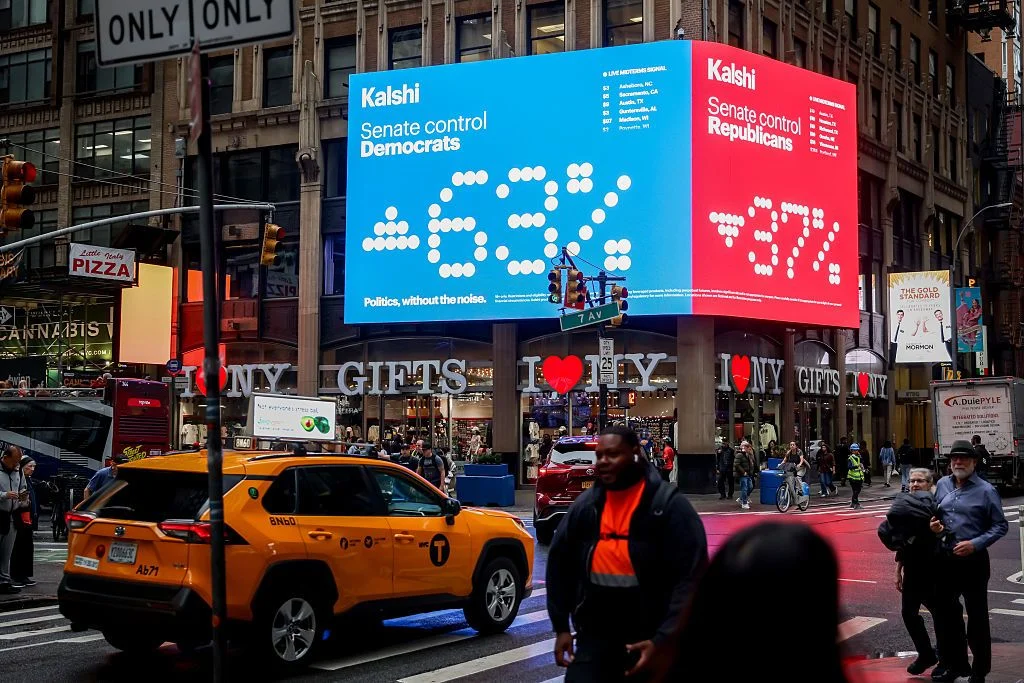
Kalshi and Polymarket are the largest platforms described in the source. Both began around the pandemic era and later drew much wider attention. Kalshi was valued at £22 billion after quadrupling in less than a year, and it had more than 10,000 live markets. Sport accounted for about 78% of its trading volume, a reminder that broad menus of contracts don’t necessarily mean users trade evenly across topics.
The possible subjects range from weather-related events to pop culture and public figures. That variety is part of the appeal: users can trade on questions they already follow. It can also blur the boundary between a forecast and a wager. A contract price may be presented as a probability, but the underlying activity still involves risking money on an uncertain result.
Prediction markets have a long history. Americans traded on political outcomes as far back as George Washington’s era, before those markets faded and polling took on a larger role in forecasting. The University of Iowa launched a serious election market in 1988; it developed a better record than Gallup at predicting future results. PredictIt, a nonprofit platform, followed in 2014. Today’s platforms bring the format to a much larger online audience.
Why a market price can attract attention
The strongest case for prediction markets is that participants may bring different bits of information to the same question. In theory, trading combines those views into one price, much as a busy market can reflect what buyers and sellers collectively know. Polymarket chief Shayne Coplan has described his site as a “global truth machine,” invoking economist Friedrich Hayek’s argument that markets can gather knowledge spread across many people.
That idea has attracted attention from media companies and financial researchers. Kalshi has made deals with CNBC, CNN and the Associated Press; Polymarket announced partnerships with Dow Jones and Substack. Morgan Stanley found in August that Kalshi was more accurate at predicting CPI inflation than the economist consensus forecasts compiled by Bloomberg. A result like that can make the platform useful as one forecasting signal. It doesn’t show that every market is accurate, or that users can reliably trade at a profit.
Most users may not share in the gains
Kalshi and Polymarket averaged about $1.6 billion in daily trading in August, nearly 2,000% more than a year earlier. High volume can make it easier to enter or exit a position, but it doesn’t remove the risk of losing money. Nor does the absence of a traditional bookmaker’s “house edge” ensure fair outcomes for each trader.
A study by the Centre for Economic Policy Research in June found that two-thirds of Polymarket users lost money. The same study reported that the most profitable 1% of traders took more than three-quarters of the profits, while the top 0.1% captured half. The Wall Street Journal reported in May that nearly half a billion dollars went to fewer than 2,000 accounts and that the median loss last year was $94.
Those figures point to a structural challenge for casual users. Less experienced participants may supply the trades and liquidity that let more skilled traders act on prices they see as wrong. Professional traders and AI tools can make it harder for a person placing occasional bets to spot an advantage. A quick exit may be possible, but that doesn’t guarantee a good price when the user wants to leave.
Convenience and risk go together
These platforms are always online, often require a small initial commitment and can give users fast feedback. Positions may be easy to close, and AI tools can help users examine information. Those features lower the effort involved in taking part; they don’t turn a speculative trade into a dependable way to build savings.
The audience is often young and male, though platforms are trying to appeal to more women through female influencers, in-person events and contracts on pop culture. Kalshi told the BBC that women’s share of its users rose from 13% in early 2025 to 26% by early 2026. Betterment, a US financial adviser, found that 52% of Gen Z investors diverted money intended for investing into sports betting last year. The Harris Poll found that nearly two-thirds of Gen Z and millennials thought gambling or crypto was the only way to build wealth.
That outlook may help explain why the format resonates, but it also makes budgeting choices worth considering. Money set aside for rent, bills, debt payments or long-term goals has a different job from money someone can afford to lose. Before taking part, a user can decide in advance how much they’re willing to risk and avoid treating a profitable streak as proof that future bets will pay off.
Access and rules depend on where you live
In the US, prediction markets are treated as derivatives under the Commodity Futures Trading Commission framework, rather than as gambling. That classification has allowed platforms to operate across areas where sports wagering rules differ. The source also describes a less welcoming picture in Europe, where the platforms are largely unauthorised and the EU markets regulator has warned of significant risks and insider trading.
In the UK, the rules depend on the kind of contract. Since 2019, the Financial Conduct Authority has barred the binary options offered by Kalshi and Polymarket to UK customers, while overseeing prediction markets tied to financial or certain climate events. The Gambling Commission handles sporting and political outcomes, which it describes as akin to betting exchanges. Betfair, Matchbook and Smarkets are cited as legal examples of that model, which Britain has allowed since 2000.
Some UK users have tried to reach Kalshi or Polymarket through VPNs, including to trade on local political contests. That may expose them to risks around access and protections. The platforms have begun lobbying for a different financial-services status, and the Financial Conduct Authority is considering changes to its rules. For now, anyone considering a contract needs to check whether the platform and product are available to them, and to treat a market price as a forecast with uncertainty attached—not as a safe place to park money.