Amazon’s Flywheel: How Customer Focus Built Businesses Beyond Retail
Budgeting & Saving [email protected] (Jamie Ward) 748 reads
Amazon’s growth has rested on reinvesting in lower prices, better service and shared infrastructure, from Prime and advertising to AWS.
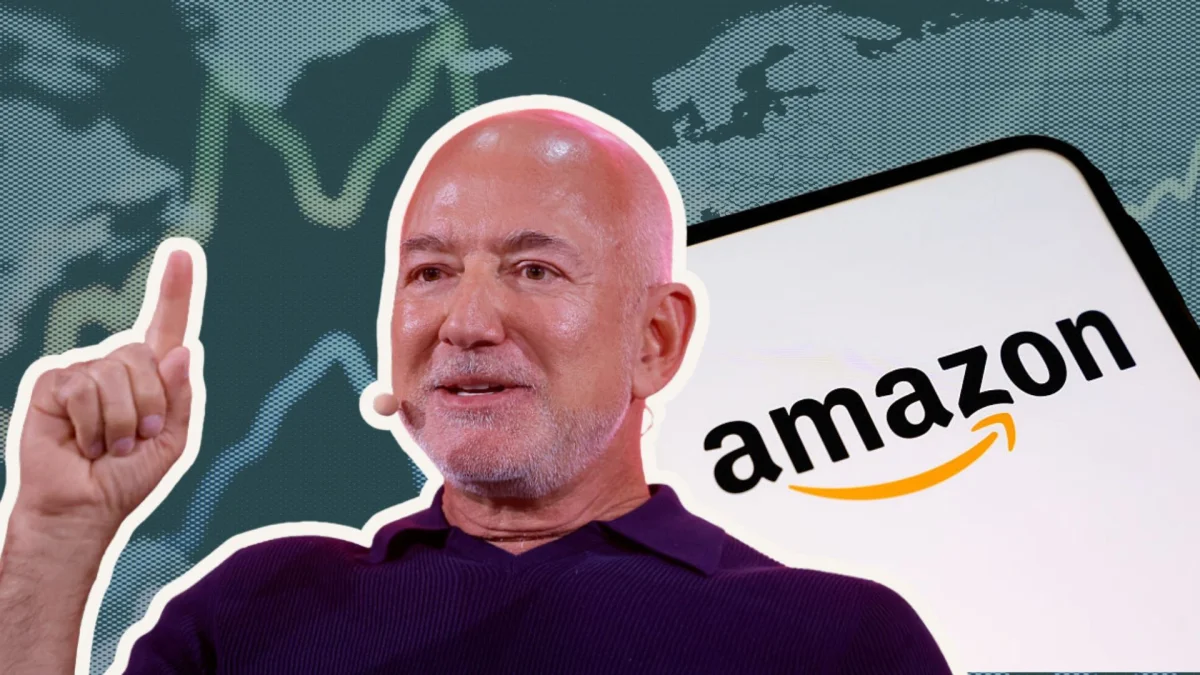
Amazon’s most valuable business grew from a simple operating idea: use scale to make the customer offer better, then use the resulting growth to build more scale. That cycle began with books and now reaches across online retail, subscriptions, advertising and cloud computing. It helps explain why Jeff Bezos registered relentless.com in 1994, even though friends talked him out of using Relentless as the company’s name.
Bezos settled on Amazon because he wanted a name that suggested vastness. His ambition was to build the world’s largest bookstore and, eventually, an “everything store.” Yet Relentless may have described the company’s method more clearly: pursue lower costs and better customer service, then reinvest the gains rather than treating them as immediate profit.
A business designed around scale
Bezos saw that online retail could work differently from a chain of physical shops. An online company didn’t need thousands of stores or sales assistants, and technology could process more transactions without costs rising at the same pace. As sales grew, Amazon could spread fixed costs across more orders and use the resulting savings to improve prices and service.
In 2001, Bezos gave this reinforcing cycle a memorable image: the Amazon flywheel. He reportedly sketched it on a napkin after an internal retreat with business writer Jim Collins. Lower prices attract more customers; more customers generate more sales and scale; greater scale makes lower prices easier to offer. The sketch captured an established way of thinking: accept weaker profits in the present if the spending builds a larger, more useful business over time.
That logic shaped Amazon’s first product choice. Bezos, then leaving a successful career at investment firm D.E. Shaw, ranked products by their suitability for online sales. Books stood out because millions of titles existed, far more than even a large shop could stock. There were only two distributors, which made sourcing relatively simple, and books were uniform in size and shape, making them easier to package. Online retail could offer a breadth of choice that physical shelves couldn’t match: more than three million titles, rather than tens of thousands.
The idea still carried a high chance of failure. When Bezos’s parents put a large share of their savings into the venture, he warned them that he thought there was a 70% chance they would lose the money. In other words, he saw a 30% chance of success, about three times the odds he assigned to a typical start-up. He had a large ambition, but chose a narrow starting point where the internet offered a clear advantage.
Turning that idea into a business took months of investor pitches and more than 50 meetings before Bezos raised $1 million. One question came up repeatedly: “What’s the internet?” His parents contributed about $250,000 of the initial funding. Their investment is now worth several tens of billions of dollars.
From a home operation to a public company
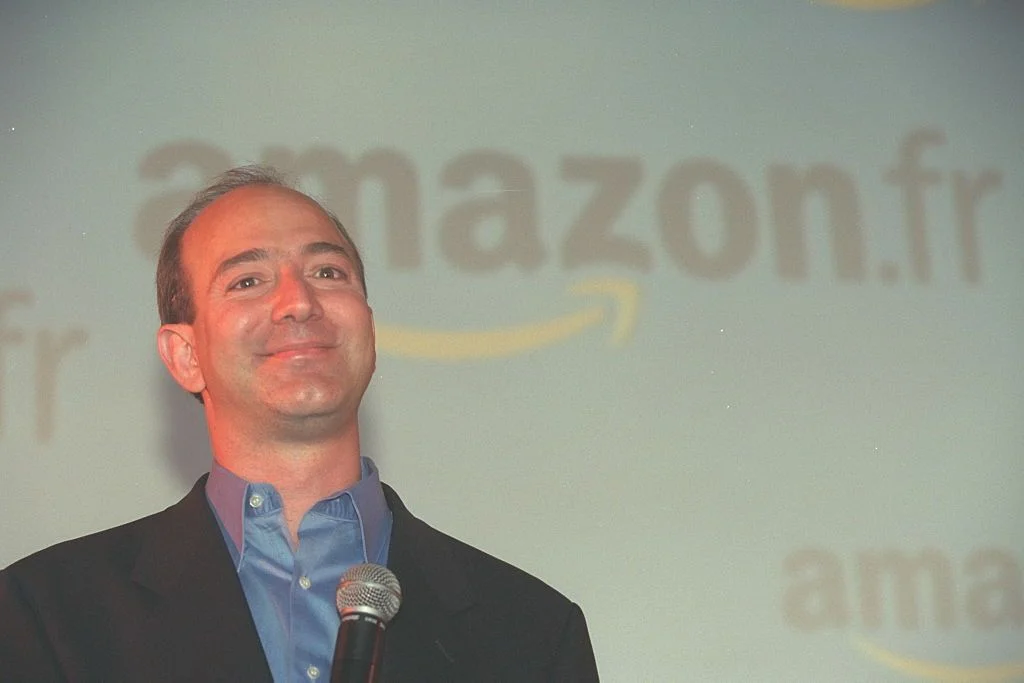
Amazon opened in July 1995 from Bezos’s home in Bellevue, Washington. Its frugal culture was visible in desks made from doors and a habit of treating every dollar as important. The book business also had a useful cash-flow feature. Wholesalers held large catalogues, so Amazon could list many titles without buying and storing every one. Customers paid Amazon when they ordered, before Amazon had to pay its suppliers. That timing helped the young company finance expansion.
When Amazon went public in May 1997, Bezos set out his priorities in his first letter to shareholders. He said the company would favour long-term growth over short-term profit, track customer growth and repeat purchases, and make bold investments even when the eventual returns were uncertain. If the choice was between earnings now and building a more valuable company later, he was prepared to sacrifice near-term profit.
He also described the internet as being in “Day 1.” For Amazon, that meant keeping the habits of a young business as it grew: experiment, invest and adapt instead of protecting the status quo. The company soon moved beyond books, adding music and other categories. Third-party sellers began using the site too, turning Amazon from a retailer of its own stock into a marketplace.
The late 1990s brought a rush of money into internet businesses. Investors backed companies promising rapid growth, including firms with little revenue and no profit. Amazon benefited from the enthusiasm and also made investments and commercial agreements with other young online businesses.
Pets.com became a prominent cautionary example. The online pet-supplies retailer, backed by Amazon and others, floated in February 2000 and failed before the year ended. It had spent heavily to attract customers before proving it could serve them profitably. As faith in internet companies faded, funding dried up and hundreds of businesses failed. Amazon survived, but its share price dropped from more than $100 at its peak to less than $6.
The crash sharpened the distinction between growth for its own sake and spending that could strengthen a lasting advantage. Amazon cut costs and became more disciplined, while keeping the long-term approach Bezos had described to shareholders. It concentrated on making its core business more useful and efficient as it grew. The company still had a larger customer base and a wider selection, and it was learning to operate without easy access to funding.
Turning internal systems into AWS
Amazon’s next major expansion came from asking what else its own capabilities could do. The company had developed systems to handle millions of orders, operate warehouses and move products around the world. Bezos saw that technology built to run retail could support businesses beyond retail. If Amazon built shared systems that could be used repeatedly, one investment could serve many different activities.
Amazon Web Services (AWS) grew out of an engineering problem inside the company. As Amazon expanded, its teams were spending too much time building basic technology for each project. They kept creating separate storage systems and computing capacity. Amazon’s answer was to build reliable shared infrastructure once and let developers access it when needed.
The company then recognised that outside developers might want the same thing. Instead of buying servers, installing them and maintaining them, a small business could rent storage or computing power from Amazon and pay for what it used. That made computing capacity available without a large upfront purchase.
Amazon tested the idea in the early 2000s. It launched S3, an online storage service, in 2006, followed by EC2, which let customers rent computing capacity. Cloud computing is now commonplace, but at the time it offered small firms access to infrastructure that previously required significant resources to build and maintain. Amazon had invested in this capacity for its own retail needs; selling access let it spread that investment across many more customers.
Investors initially had trouble making sense of a bookseller selling computing infrastructure. Developers saw the practical appeal sooner. A couple of engineers working from a flat could rent storage and computing capacity rather than buying a room full of servers or signing a large technology contract. AWS lowered one of the barriers to starting and scaling a software business.
For years, AWS’s financial contribution was difficult to see because Amazon grouped its revenue in a segment called “Other Revenue.” When the company first reported AWS separately in 2015, it had $7.9 billion in revenue and $1.9 billion in operating profit, a margin of almost 24%. In the most recent full year cited, AWS generated $128.7 billion in revenue and $45.6 billion in operating profit. A service that began partly to solve Amazon’s own computing needs had become a major business in its own right.
AWS shows a pattern that runs through Amazon’s history: solve a problem inside the company, turn the solution into a service others can use, and keep investing as the customer base grows. The same infrastructure can make Amazon’s own operations work better while generating income from outside businesses.
Prime and the value of repeat customers
Prime applied the flywheel to customer loyalty. Launched in 2005, the service replaced a familiar choice: shoppers could wait for free delivery or pay extra for faster shipping. Bezos wanted customers to get fast delivery for no additional charge on each order, in exchange for an annual membership fee. That raised a real cost question, particularly for members who ordered frequently and made full use of unlimited two-day delivery.
The bet changed how members shopped. Once customers had paid for Prime, each order carried less of a delivery cost decision, and there was less reason to look elsewhere. Members tended to shop more often and spend more with Amazon. The annual fee helped create a customer base with stronger reasons to keep returning.
Amazon later added services to make the membership more appealing. Its 2011 acquisition of LoveFilm helped lay the groundwork for streaming. The company went on to spend billions on original films and television programmes and to secure live sports rights. Those investments make more sense as part of a subscription strategy than as a simple move from retail into entertainment: more valuable benefits can give members more reasons to stay and bring more of their spending to Amazon. Bezos summed up the connection this way: “When we win a Golden Globe, it helps us sell more shoes”.
The company has also been willing to respond to changes that could undermine an existing business. As digital music challenged physical media, Bezos backed the Kindle, moving Amazon into digital books before the shift became impossible to ignore. Third-party sellers brought millions of products to the marketplace, and Amazon built an advertising business around the search traffic those listings attracted. Advertising now generates tens of billions of dollars in annual revenue.
Artificial intelligence is the latest area where Amazon is applying its infrastructure. AWS offers computing power, chips and software tools for businesses developing and running AI applications. Amazon is also using the technology internally, including in warehouse automation and product recommendations. The familiar approach is to build capabilities that can support Amazon’s own operations and be sold to outside customers.
Since Bezos stepped down as chief executive in 2021, Andy Jassy has led the company. Jassy joined Amazon in 1997 and worked closely with Bezos before building AWS from an internal project into a major technology business. His challenge is to keep Amazon experimenting and investing while applying discipline to a company operating at enormous scale. The post-pandemic cost-cutting programme also showed that the approach can mean trimming operations when the business has grown too large or inefficient.
What the growth story means for investors
Amazon has often looked expensive when judged only by current profit or cash flow. To understand the company, investors have had to consider what its spending might build in later years. That remains part of the story, although Amazon’s size makes a repeat of its early percentage gains unlikely. Its businesses span online retail, cloud computing and advertising, each operating at substantial scale. The open question is whether Amazon can keep turning that scale into new sources of growth.
The company’s history points less to one predictable next technology than to a repeatable way of working: invest in infrastructure, use it to improve existing services, and look for other customers who can benefit from it. AWS is the clearest case, while Prime, advertising and logistics show related efforts to spend now for benefits that may emerge over time.
Relentless remains a fitting description of that approach. Amazon has spent decades trying to lower costs, improve the customer experience, reinvest savings and find new uses for the systems it has built. Its future growth will depend on whether that cycle can keep producing useful businesses as the company grows larger and the next opportunity is still difficult to see.